
Application and Practice of Reverse Osmosis Membrane Technology in Commercial Water Purification

Explore the technical advantages, application cases, and maintenance best practices of reverse osmosis membrane technology in large-scale commercial water purification.
I. Technical Overview: What is Reverse Osmosis Membrane Technology?
Reverse Osmosis (RO) technology originated in the 201960s in the U.S. space sector, initially developed to recycle drinking water for astronauts. Today, RO is widely used for drinking water purification, pharmaceutical production, ultrapure water in electronics manufacturing, and seawater desalination.
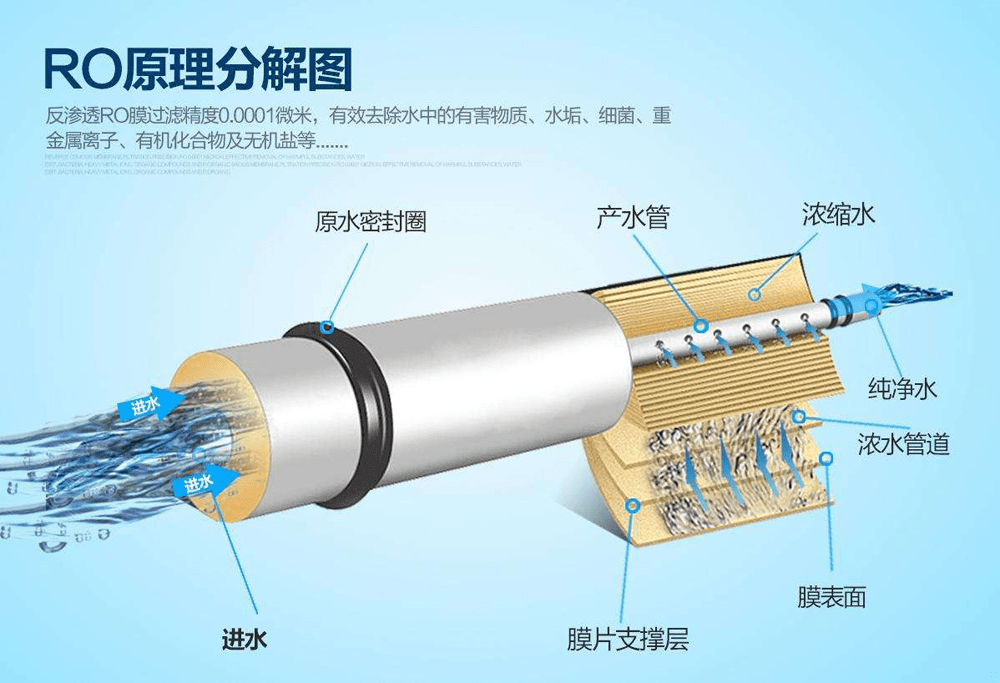
Reverse osmosis membranes are ultrafine physical barriers that mimic the selective permeability of cell membranes. Under pressure, they allow only water molecules to pass while efficiently blocking dissolved salts, heavy metals, bacteria, viruses, organic matter, and other impurities.
Simply put, the reverse osmosis membrane acts like a precise "molecular sieve"—allowing water molecules to pass through while blocking harmful contaminants. Reverse osmosis desalination is a physical process: under pressure, water passes through the membrane, while salt ions, organic compounds, and bacteria are held back. This is why RO systems can remove over 98% of ions and organics, as well as 100% of microorganisms.
Key Metrics: The reverse osmosis membrane filtration precision reaches 0.0001 microns (0.1 nanometers)—about one-millionth the diameter of a human hair. Salt rejection is the critical performance indicator for RO membranes; high-quality membranes achieve a salt rejection rate of 96% to 99%.
II. Why Has Reverse Osmosis Become the Mainstream Technology for Commercial Water Purification?
Most thorough purification
Compared to microfiltration (MF) and ultrafiltration (UF), reverse osmosis (RO) offers the highest filtration precision. While UF removes bacteria and colloids, it cannot eliminate dissolved salts or heavy metal ions from water. RO removes over 98% of ions and organics, plus 100% of microorganisms in a single pass, producing water safe for direct drinking. For commercial settings—schools, hospitals, office buildings, factories, and more—water safety is non-negotiable; RO remains the most reliable choice.
Mature technology, high market share
In the global water purification market, reverse osmosis (RO) technology holds a dominant position. The global RO water purifier market is projected to reach $1 billion in 2025, growing to $3 billion by 2032. In China, while the share of RO technology in water purifiers has declined, it remains around 58%. This means that nearly 6 out of every 10 commercial water purification units utilize reverse osmosis technology.
Intelligent upgrades continue to empower
Technical trends in 2025 include integrating IoT sensors for real-time monitoring and using AI algorithms to optimize operating parameters. Intelligence transforms reverse osmosis systems from "passive filtration" to "active management"—enabling real-time water quality monitoring, automatic filter life alerts, and remote equipment diagnostics, significantly reducing manual maintenance costs.
3. Typical Application Scenarios of Reverse Osmosis Membranes in Commercial Water Purification
Scenario 1: Campus Drinking Water
Campus drinking water safety affects countless families. Reverse osmosis technology effectively removes harmful substances such as heavy metals, bacteria, and viruses, ensuring safe drinking water for teachers and students. Currently, piped direct drinking water is widely implemented in schools by installing water purification stations that use reverse osmosis membranes to remove contaminants, then distributing the treated water through independent circulation networks to classrooms, dormitories, and offices. The industry standard follows a "deep treatment + recirculation" approach. For example, a vocational college's direct drinking water project includes over 1500 terminals, serving classrooms, dorms, and offices.
Baiyuan Practice: Baiyuan Water has supplied campus direct drinking water systems to many educational institutions, including Sun Yat-sen University, Sino-British College (Sun Yat-sen University), Hailo Lide School Zhuhengqin, and Zhongshan Memorial High School, building extensive experience in campus projects.
Scenario 2: Hospitals and Healthcare Facilities
Hospitals have stringent water quality requirements. Medical purified water must meet a conductivity standard of ≤2μS/cm, and hemodialysis water must comply with YY0572. Reverse osmosis technology reliably produces high-purity purified water to meet the needs of various departments, including laboratories, sterile supply rooms, and dialysis centers.
Baiyuan in Practice: Baiyuan Water Industry has delivered whole-hospital quality-differentiated water supply systems for medical institutions such as Zhuhai People's Hospital and Zhuhang Shangchong People's Hospital. Our solutions cover multiple categories including potable water, medical purified water, and softened water, building extensive experience in healthcare water projects.
Scenario 3: Office Buildings and Commercial Spaces
Enterprise office environments demand high flow rates, sleek designs, and low maintenance. Our reverse osmosis drinking water systems serve 30–200 people with a single unit, delivering purified water with TDS levels below 50mg/L. Integrated smart IoT capabilities allow administrators to monitor water quality, filter life, and consumption in real time via mobile devices for seamless digital management.
Baiyuan in Practice: Baiyuan Water has served numerous government and enterprise clients, including China Merchants Bank's Guangzhou Headquarters, Zhuhai Jinwan District Tax Bureau, and Hengqin Guangdong-Macao In-Depth Cooperation Zone People's Court. We provide office drinking water system design and installation services.
Scenario 4: Dining & Hospitality
Coffee, tea, and ice production are highly sensitive to water quality. Residual chlorine affects beverage taste, while scale damages equipment like coffee machines and ice makers. Reverse osmosis removes residual chlorine, odors, and hardness ions to ensure pure flavor and extend equipment lifespan.
Byeyuan in Action: Byeyuan Water has supplied catering water purification systems for Jingyun Hotel on Zhuhai's Wailingding Island (Gree Real Estate) and the food court at Huafa Mall, covering scenarios such as kitchen water purification, ice machine filtration, and coffee machine water treatment.
4. Maintenance and Cost Control of Reverse Osmosis Systems
The core cost of reverse osmosis systems lies in RO membrane replacement. Scientific maintenance is key to extending membrane life and reducing operating costs.
RO Membrane Lifespan and Replacement Cycle
The typical lifespan of an RO membrane is 2–5 years, averaging about 3 years. However, the belief that "membrane life = 3 years" is a misconception—actual longevity depends on feedwater quality, pretreatment effectiveness, water usage patterns, and maintenance quality. Regular flushing (such as automatic post-shutdown RO membrane rinsing) and timely replacement of pre-filters can extend the membrane's life to 3–4 years.
Maintenance Cost Breakdown
Single industrial-grade RO membrane costs approximately 3000-8000 CNY. Pre-filtration cartridges (PP cotton, activated carbon, etc.) require replacement every 3-6 months. Delayed maintenance (e.g., clogged filters not replaced promptly) can cause irreversible fouling of the RO membrane, necessitating premature element replacement and increasing single-time costs by an additional 8000-15000 CNY.
Why Choose Baiyuan for Operations & Maintenance Services
Baiyuan Water Industry offers fully managed operations services to help customers effortlessly manage RO systems.
Proactive Inspection: Regular on-site checks of equipment status and water quality metrics
Filter Reminder: IoT system monitors filter lifespan in real-time and proactively alerts you when replacement is due.
Rapid Response: 30-minute response, 4-hour onsite arrival, 8-hour repair; free backup device provided if service exceeds SLA.
Service Commitments in Contract: Qixing Service Certification – Standards explicitly detailed in writing within the contract.
V. Development Trends in Reverse Osmosis Membrane Technology
Breakthroughs in New Membrane Materials Continue
Traditional reverse osmosis (RO) membranes are primarily polyamide (PA) composite membranes. In recent years, research into new membrane materials such as graphene has advanced significantly, offering the potential to improve filtration speed and durability. The Chinese Academy of Sciences has developed a dual-functional RO membrane with enhanced antimicrobial and anti-fouling properties, effectively addressing the industry-wide challenge of biofouling.
Low power consumption is becoming a key direction.
Energy consumption for seawater desalination via reverse osmosis has dropped to as low as 3kWh/m³. Low-salt-rejection RO membranes show potential for reducing energy use and costs in zero-liquid-discharge wastewater systems. Continued reductions in energy consumption will further expand the application of RO technology in commercial water purification.
Deep integration of intelligence and IoT
Integrating IoT sensors for real-time monitoring and AI algorithms to optimize operating parameters has become an industry standard. Future reverse osmosis systems will feature self-diagnosis, self-alerting, and self-optimization capabilities, further reducing the need for manual intervention.
VI. Baoyuan Water Industry's Reverse Osmosis Technology Expertise
As a national high-tech enterprise (Certificate No.: GR202444008196) with over a decade of expertise in water treatment, Baiyuan Water Industry holds the following core advantages in reverse osmosis technology:
Supply Chain Advantage: We represent top-tier international and domestic brands including 3M, GE, Pentair, A.O. Smith, Midea, Angel, Qinyuan, and Bili. All reverse osmosis units are equipped with premium RO membrane elements, ensuring stable salt rejection rates of 96%-99%.
Comprehensive Capabilities Across All Scenarios: From campus drinking water and hospital purified water to industrial ultrapure water, Baiyuan Water Industry provides complete reverse osmosis solutions for commercial drinking water, industrial pure/ultrapure water, and medical purified water.
Quality Assurance: Equipped with industry-leading manufacturing and inspection equipment including fully automatic stainless steel pipe welding systems, online eddy current flaw detectors, and spectrometers, we strictly adhere to ISO9001 quality management standards in our production.
Service Commitment: Certified under the Seven-Star After-Sales Service System (GB/T27922-2011, the highest seven-star level). We guarantee 30-minute response, 4-hour on-site arrival, and 8-hour repair. If we exceed these timeframes, a replacement device will be provided free of charge. Our service standards are included in the contract. The company has been recognized for five consecutive years as a Guangdong Province "Contract-Abiding and Creditworthy Enterprise."
VII. Conclusion
Reverse osmosis (RO) technology, with its superior purification performance and mature application ecosystem, has become an indispensable core solution in the commercial water treatment industry. From schools to hospitals, office buildings to hotels, RO systems are delivering safe, pure drinking water to millions of users worldwide.
Baiyuan Water Industry will continue to deepen its expertise in reverse osmosis technology, delivering professional, full-scenario water treatment solutions to help more enterprises and institutions upgrade their drinking water—ensuring every drop is clean, safe, and reliable.
Guangdong Baiyuan Environmental Protection Technology Co., Ltd.
Company Address: Room 2101, Building A, Zhengfang Yunxi Valley, Xiangzhou District, Zhuhai City
Official Website:www.beryon.cn
Phone: 0756-6230686
Published: 2026-2
Recommended Related Cases

Robust Guangzhou Production Base Dual-Stage Reverse Osmosis Pure Water System Project Case | Baiyuan Water Industry
Robust Group utilizes Baiyuan Water Industry's dual-stage reverse osmosis pure water system. The produced water meets GB 19298-2014 packaging drinking water standards, with a bottled water production capacity of 2400 buckets per hour. Multi-stage pretreatment + dual-stage RO + terminal sterilization combination...
View Details
Zhuheng Hengqin Harrow Li De School Direct Drinking Water System Project Case | Baiyuan Water Industry
Baiyuan Water Industry provides a safe and healthy campus drinking water system for Zhuhai Hengqin Harrow School, covering primary, middle, and high school teaching buildings as well as dormitory areas. The system features a combination of 3M commercial drinking water purifiers and Shijifengyuan energy-saving drinking fountains, equipped with over...
View Details
Zhuhie Inbott Electric Co., Ltd.
Secondary RO + EDI + Nuclear-Grade Resin Ultrapure Water System; produces ultrapure water for new energy equipment manufacturing (resistivity > 18.2 MΩ) and direct drinking water in the workshop.
View Details